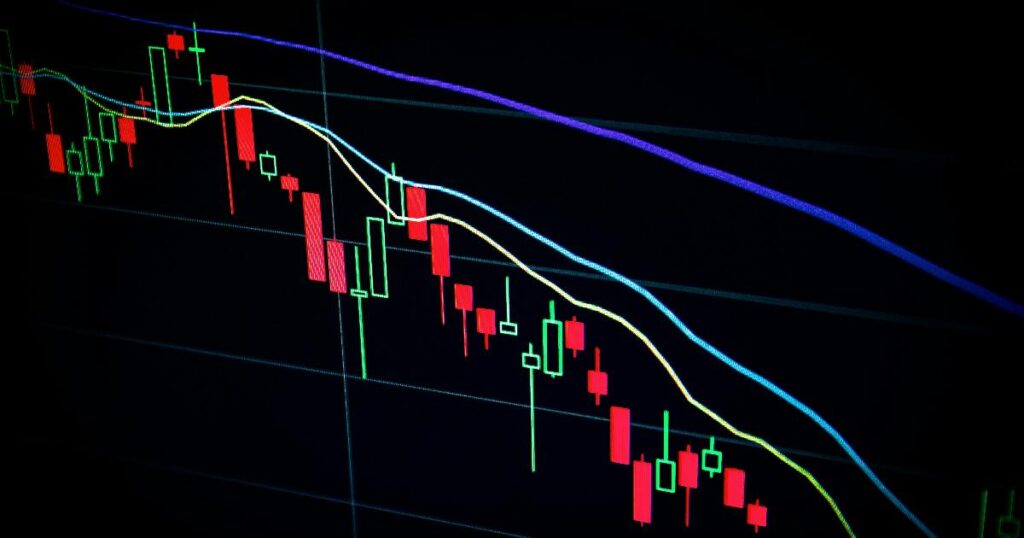
This is the trap that catches investors after a panic sale: not the original loss, but the slow, invisible cost of staying out. Cash feels safe because nothing is happening to it. Yet every day you leave it on the sidelines is itself a decision about the market — one made by default rather than by plan.
Fear Spikes Fast. It Also Fades Fast.
The case for urgency around this topic rests on a simple, well-documented pattern: volatility tends to spike sharply and then normalize quicker than investor confidence does. The CBOE Volatility Index, a gauge of how much price swing options traders expect from the S&P 500 over the coming month, jumped to 31.05 in late March 2026, a level consistent with elevated market fear. By October 8, it had fallen back to 15.41, squarely inside its typical range.
It’s worth being precise about what that number does and doesn’t mean. The VIX is derived from options prices, not from a tally of actual price swings that already happened, and a return to a "normal" reading says nothing certain about where the market goes next. It measures the market’s priced-in anxiety at a moment in time, not a forecast with any guaranteed accuracy. What the swing does illustrate, though, is how quickly the emotional backdrop can shift — often well before an investor who sold in panic feels ready to come back.
That mismatch between the pace of market sentiment and the pace of personal confidence is the real subject of this piece. Recoveries have a habit of arriving in short, uneven bursts, frequently while the mood is still sour and the headlines are still bad. Waiting for the moment when re-entry feels obviously safe means waiting for a moment that, by its nature, shows up after the gains are already priced in. Confidence is a lagging indicator of the market, not a leading one.
Why the Decision to Sell Was Not the Whole Story
It’s fair to credit the original instinct. An investor who sold ahead of a long decline genuinely avoided further losses for a stretch of time. That part of the decision was not irrational, and selling during a downturn is not automatically a mistake — investors with real liquidity needs, upcoming expenses, or portfolios that have drifted far from target allocations have legitimate reasons to reduce exposure regardless of sentiment. The distinction that matters is intent: selling to meet a defined need is different from selling because the news felt unbearable.
Where the trouble starts is afterward. Behavioral research on investor returns has repeatedly found that the widest gap between what a fund earns and what an actual investor in that fund earns comes not from fees or fund selection, but from poorly timed exits paired with delayed re-entries. The decline itself is often temporary; it’s the sitting-out that can turn it into something closer to permanent. Some of the strongest rebound days in market history have clustered during or immediately after periods of high stress — before economic data improved, before headlines turned positive, before most investors felt any confidence returning. An investor in cash during that window captures none of it.
None of this means missing a rebound always outweighs avoiding a drawdown — the balance depends entirely on the specific path markets take afterward, which cannot be known in advance. But as a general pattern, it explains why "I’ll get back in when it feels safer" is not a neutral, risk-free stance. It is itself a timing bet, just one made unconsciously.
A Plan Written in Calm Beats a Decision Made in Fear
If waiting for certainty is the trap, the practical alternative is removing the decision from the moment of emotion altogether. One approach discussed around this problem is a re-entry schedule set in advance: specific dates and specific amounts, decided while calm, then followed regardless of how the headlines read that week. The schedule doesn’t ask for conviction that the market has bottomed — it only asks for consistency. That single substitution, rules instead of real-time judgment, is also the core recommendation behind research into why investors struggle with panic-selling in the first place: the fix is less about willpower and more about limiting discretion at the exact moment discretion is least reliable.
To be clear-eyed about it, a staged plan does not eliminate market risk, and it cannot guarantee a smoother outcome than reinvesting all at once. Whether spreading purchases over several months outperforms a single lump-sum move depends on the market’s path during that window, and that path is unknowable in advance. What a staged plan offers instead is something more modest but still valuable: a way to act without needing to feel ready, and a defense against the specific failure mode of waiting indefinitely.
Rebuilding Exposure to Match the Investor You’ve Already Proven You Are
A re-entry plan also needs a destination — some mix of holdings that fits the risk tolerance an investor revealed when they sold in the first place. Three exchange-traded funds illustrate different shapes that rebuilding can take, not as a recommendation for any particular reader, but as a way to see the trade-offs clearly.
| ETF | Role | What it holds | Trailing performance (through early Oct. 2026) | Behavioral trade-off |
|---|---|---|---|---|
| iShares Core 80/20 Aggressive Allocation (AOA) | One-decision re-entry | ~46% S&P 500, ~23% developed international, ~9% emerging markets, ~19% bonds, rebalanced automatically | Up 10.88% year-to-date, 55.82% over five years | Removes the need to pick among many funds, but still carries meaningful equity volatility |
| Schwab U.S. Large-Cap (SCHX) | U.S. equity core | Broad large-cap exposure across sectors, very low cost | Up 14.8% year-to-date, 16.61% over one year, 323.76% over ten years | Full exposure to U.S. stock swings; no bond cushion |
| Vanguard Intermediate-Term Corporate Bond (VCIT) | Ballast | Investment-grade corporate bonds, roughly 5–10 year maturities, monthly payouts, trailing yield near 5.1% | Down 2.89% year-to-date as the 10-year Treasury yield rose to 5.22% from 3.97% | Dampens swings but carries credit and rate risk; bond funds can lose value too |
The pattern across all three: AOA and SCHX overlap heavily in U.S. large-cap stocks, so combining them doesn’t necessarily add diversification, only a different balance of convenience versus control. VCIT behaves differently — it’s meant to smooth the ride, not maximize it, and its decline this year is a reminder that bond prices move inversely to yields, so a stretch of rising rates can hurt a bond fund’s price even while it keeps paying income. None of these funds is immune to loss, and these returns describe what already happened, not what comes next.
The Honest Trade-Off
Diversification across these pieces doesn’t remove the possibility of losses; it reduces how dependent the outcome is on any single segment of the market. Cash, meanwhile, isn’t a risk-free parking spot either — it simply trades market risk for a quieter one, the slow erosion of purchasing power through inflation.
The uncomfortable truth behind all of this is that there is no portfolio that guarantees comfort and growth at the same time. The more useful question than "which fund performs best" is "which mix would I actually hold through the next decline, instead of selling again." A theoretically optimal portfolio abandoned at the next scare is worth less than a moderate one an investor can sit through. A re-entry schedule doesn’t erase that tension or promise a better outcome — it simply gives an anxious investor something to do besides wait for a feeling of safety that, history suggests, tends to arrive only after it’s no longer needed.